
Heating a Schuyler County farmhouse takes the right fuel, not just the right unit.
Wood, gas, pellet, and electric fireplace resources for Rushville, Astoria, Frederick, Littleton, and every rural route in between. Find the fuel that fits your home and get matched with a trusted local dealer.
Every Project Starts From One of These Five Situations
Western Illinois heating, built around oak and hickory woodlots.
Schuyler County sits in the rolling farm and timber country between the Illinois and LaMoine Rivers, with a winter heating season comparable to Madison, WI, and winter lows that average 17°F—though with less snow load. Oak, hickory, walnut, and maple grow throughout the county's timber ground, and a lot of homeowners here still burn wood they've cut themselves from their own or a neighbor's woodlot. There's no formal air quality non-attainment designation in Schuyler County, so wood burning doesn't carry the curtailment restrictions you'd see in a basin or urban county—it's simply a practical, low-cost way to heat through an Illinois winter.
What you'll find on this hub: hearth retailers, service technicians, and fuel suppliers serving Rushville, Astoria, Frederick, Littleton, Huntsville, and the unincorporated crossroads that make up most of Schuyler County's population. Pick your fuel below to see local dealers, typical installation costs, and the units that fit a county this size—where the nearest big-box store is often 30-plus minutes away and a local dealer's relationship matters more than a catalog.
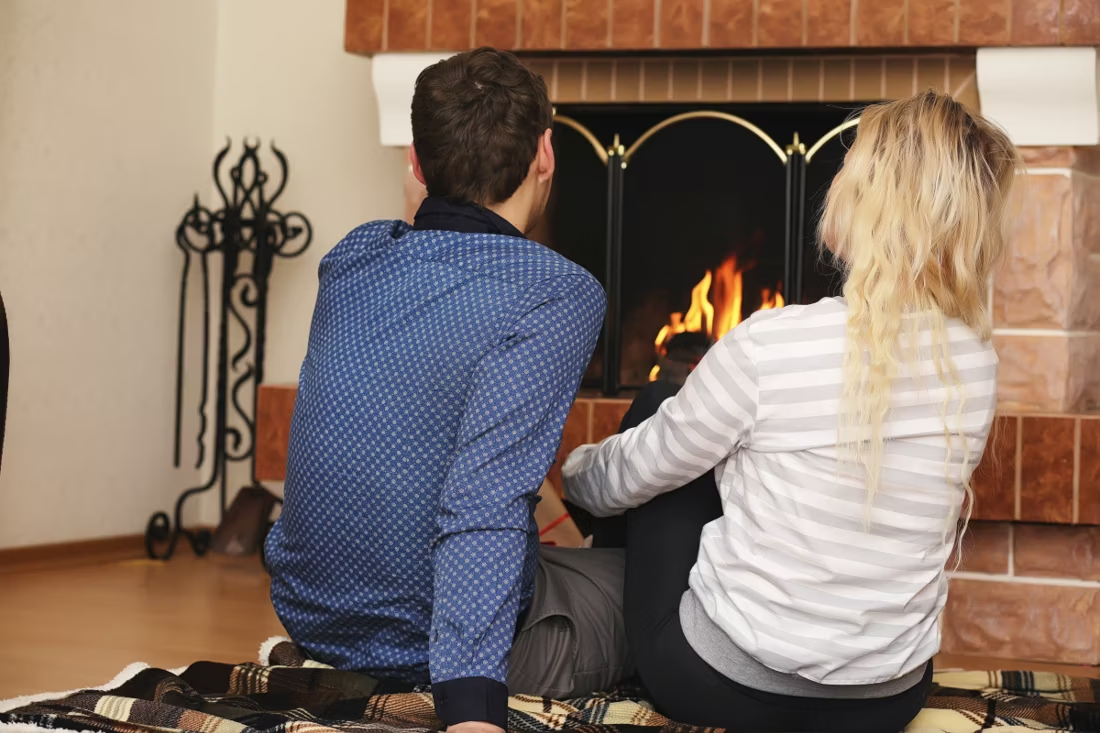
Four fuels. One honest answer for Schuyler County.
Three steps. No salesperson until you're ready.
Tell us about your project
Your zip code, your situation, and the fuel you're leaning toward—or let the answers point you to one.
See what's actually available
The brands dealers within 100 miles genuinely carry—real options, never a catalog mirage.
Get your dealer & Project Guide
A trusted local dealer, plus the free Project Guide & Parts List that names every component of the job.
Frequently Asked Questions
Which fireplace fuel makes the most sense in Schuyler County?
It depends on the home and how you already heat. Wood is a natural fit here—the county's oak, hickory, walnut, and maple timber ground means a lot of households have access to self-cut or locally sold firewood, and a mid-size catalytic or non-catalytic stove handles a winter heating season comparable to Madison, WI without trouble. Gas is the convenience option for homes with propane service (most of rural Schuyler County isn't on natural gas)—no wood handling, thermostat control. Pellet is a strong middle ground for homeowners who want wood-style heat without splitting and stacking; Indeck Energy Services and Lignetics both supply the region. Electric works well as supplemental heat in a bedroom or den but shouldn't be your only source through a county winter with 17°F average lows. Many households here run wood or pellet as primary heat with propane or electric as backup for convenience or outages.
Do I need a building permit to install a fireplace in Schuyler County?
Generally yes for anything involving new venting, a chimney, or a gas line. Wood stoves, inserts, gas fireplaces, gas inserts, and pellet stoves typically require a building permit through the county, and gas work needs a licensed propane or gas-fitter to make the connection. Because Schuyler County is largely unincorporated outside Rushville, Astoria, and the smaller towns, most permitting for rural addresses runs through the county building office rather than a city office—worth confirming with your dealer at the start of the project, since requirements can vary slightly between an in-town address and a rural route. Most local retailers handle the permit paperwork as part of the installation, so you typically aren't filing it yourself.
Do I need to worry about air quality restrictions on wood burning here?
No—Schuyler County has no air quality non-attainment designation and no winter burn curtailment program, unlike some western basin counties where inversions trap smoke near the surface. That said, a well-installed, properly sized stove still burns cleaner and uses less wood than an old smoke-dragon, so it's worth choosing a current EPA-certified unit even without a regulatory requirement pushing you toward it—especially if you're burning oak or hickory that needs a full season of seasoning to burn efficiently.
Can one local retailer handle wood, gas, pellet, and electric?
Some can, but in a county this size, expect more specialization than you'd find in a bigger market. A dealer based in Rushville or a neighboring town like Macomb or Beardstown may carry two or three fuel types well and refer out for the fourth. If you're cross-shopping fuels—say, deciding between a wood insert and a pellet stove for the same fireplace opening—ask up front which units the dealer keeps in stock or on display versus special-order, since travel distance in rural Illinois makes in-person comparison shopping less convenient than in a metro area.
How does service work if I'm out on a rural route, not in Rushville?
Most technicians serving Schuyler County are based in or near Rushville and travel out to Astoria, Frederick, Littleton, Huntsville, and rural addresses along the county roads. Expect a modest trip charge for addresses well outside town, and plan on booking your annual sweep or gas inspection in late summer or early fall—before the rush that hits every chimney sweep and gas tech once temperatures drop and everyone remembers their unit needs service. If you're burning wood as a primary heat source, an annual sweep isn't optional; a season of oak and hickory builds creosote faster than softer woods.
What does fireplace installation typically cost across fuel types in Schuyler County?
Costs run close to broader Midwest averages, sometimes slightly lower given local labor rates. Wood stove or insert: roughly $4,000–$8,500 for a typical install, more if new masonry chimney work is required. Gas fireplace, insert, or stove: roughly $4,000–$10,000, with propane tank and line work adding to the lower end of that range for rural properties without existing gas service. Pellet stove or insert: roughly $4,000–$7,000. Electric fireplace: $200–$2,800 for the unit itself, plus $300–$1,000 in labor for anything beyond a plug-and-play install. See the county + fuel pages above for cost detail tied to local retailer pricing.
What is an in-home preview and do I need one?
It's a visit where a hearth professional measures your space, confirms the model you picked actually works in your home, and walks the specs—framing, gas line, venting, finish work—before anything is ordered. Some details you just can't know until you see the house. Never make a down payment without one; it's the single most-skipped step that burns buyers.
Should the dealer who sells my fireplace also install it?
Ideally, yes. A fireplace project involves vent pipe, gas line, electrical, and often tile or stone. Hire three or four separate trades and you own the liability and the game of telephone between them. One company selling and installing means one accountable party, start to finish—ask about factory training, on-time completion records, and what happens if an inspection fails.
How much should I budget for a fireplace?
For an average home—covering the fireplace, the vent pipe, and basic installation—a budget between $3,900 and $5,500 gives you a lot of options across wood, gas, and pellet. By the time you add finish work, gas line, and electrical, the average complete installation lands between $5,000 and $12,000 all-in. In a remodel or new build, a good rule is to put about 2.5% of the total project cost toward the fireplace.
I know I want a fireplace—where do I actually start?
Do two things today: snap a photo of the wall or fireplace you want to transform, and take a tape measure to the space—width, height, depth. Those two artifacts answer most of a hearth professional's first questions. Then settle fuel (wood, gas, pellet, or electric) and set a realistic budget: $3,900–$5,500 covers fireplace, vent, and basic install for most homes.
Stove and Fireplace Dealers in Schuyler County
Listings include WhyFire partner dealers, dealers we have verified as authorized for the brands we recommend, and established local businesses that carry hearth products. Every listing shows which one it is. The ones marked Preferred run on WhyFire's software, so they can show you real pricing and book your appointment right here. No manufacturer pays for placement. How we verify dealers →
Peters Heating & Ac
Peters Heating & Ac
Peters Heating & Ac
Kraus & Son's Heating
Quality Lighting
Peters Heating & Air Conditioning
Marx Fireplaces & Lighting
Keystone Products Company
Trouble-Free Plumbing Heating & Cooling Inc.
Find your fireplace fit in Schuyler County.
Pick your fuel below to get a free Project Guide & Parts List—a plan built for your home in Schuyler County, with the exact parts (including the vent kit) and a matched local dealer to install it.
Find Your Fireplace →