
Find the Right Fireplace for Life Between Two Rivers.
Wood, gas, pellet, and electric fireplace resources for every corner of Calhoun County—from Hardin to Kampsville, Brussels, Batchtown, and Golden Eagle—where oak and hickory groves have heated farmhouses for generations and ferries still carry supplies across the Illinois and Mississippi Rivers.
Every Project Starts From One of These Five Situations
A hill-country peninsula shaped by two rivers.
Calhoun County occupies a narrow, hilly peninsula wedged between the Illinois River to the east and the Mississippi River to the west—one of the most geographically isolated counties in the Midwest, reachable mainly by the Brussels, Golden Eagle, and Kampsville ferries or the single bridge at Hardin. The county sits in climate zone 5A, with real winter cold and humid summers, and its wooded bluffs are dense with oak, hickory, walnut, and maple—the same hardwoods that have fueled farmhouse stoves and fireplaces here for generations. With a population of roughly 1,500, Calhoun is one of Illinois's smallest and least-populated counties, and its economy still runs on apple orchards, vineyards, and river-bottom farmland rather than any commercial center.
What you'll find on this hub: hearth retailers, service technicians, and fuel suppliers reaching every community in the county—Hardin (the county seat), Kampsville, Brussels, Batchtown, Golden Eagle, Hamburg, and Mozier. Because the county is so sparsely populated, many homeowners here end up working with dealers based across the river in Jerseyville or Alton, or even across the Mississippi in Louisiana, Missouri. Pick your fuel below to see what's realistically available, what it costs, and who actually installs it in this part of the county.
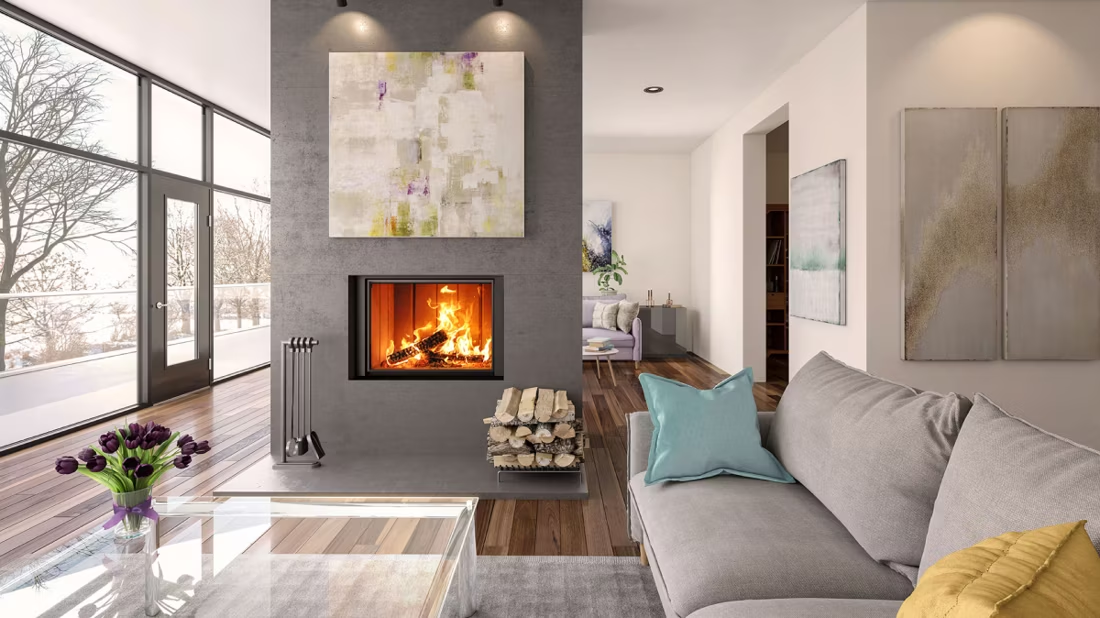
Four fuels. One honest answer for Calhoun County.
Three steps. No salesperson until you're ready.
Tell us about your project
Your zip code, your situation, and the fuel you're leaning toward—or let the answers point you to one.
See what's actually available
The brands dealers within 100 miles genuinely carry—real options, never a catalog mirage.
Get your dealer & Project Guide
A trusted local dealer, plus the free Project Guide & Parts List that names every component of the job.
Frequently Asked Questions
Which fuel works best in Calhoun County?
It depends on the home and how remote it is. Wood is the deep-rooted default here—the bluffs above the Illinois and Mississippi Rivers are thick with oak, hickory, walnut, and maple, and a lot of Calhoun County households have burned their own cut wood for generations. Gas mostly means propane, since piped natural gas service is limited to nonexistent in most of the county's rural areas—propane fireplaces and inserts give farmhouses instant heat without hauling wood. Pellet stoves are a solid middle ground, with regional supply from producers like Indeck Energy Services, Lignetics, and Somerset Pellet Fuel reaching river-town dealers. Electric fireplaces work well as supplemental heat in bedrooms or additions but won't carry a Calhoun County home through a full winter on their own. Most households here end up pairing a wood or pellet appliance for primary heat with propane or electric for backup and convenience.
Do I need a permit to install a fireplace in Calhoun County?
In most cases, yes—but the process runs through the county rather than a city office, since Hardin is the only incorporated municipality in Calhoun County and nearly everywhere else, including Kampsville, Brussels, and Batchtown, is unincorporated. Building permits typically cover new wood stoves and inserts, gas or propane appliances, and pellet stoves; propane installations also require a licensed gas-fitter for the tank and line connection. Electric fireplaces are usually permit-free unless they involve new wiring for a built-in unit. Given the county's small size, most local retailers and installers are used to handling this paperwork directly with the county rather than leaving it to the homeowner.
Are there air quality restrictions on wood burning in Calhoun County?
No—Calhoun County has no formal air quality nonattainment designation and no burn advisories or curtailment program like some more densely populated regions deal with during winter inversions. The county's low population and open river-bottom and bluff terrain mean wood smoke simply doesn't concentrate the way it can in a bowl-shaped valley or a dense suburb. That said, an EPA-certified wood stove or insert still burns cleaner and more efficiently on the same cord of oak or hickory, which matters here mainly for fuel economy and chimney safety rather than any local ordinance.
Can one local hearth retailer handle all four fuel types?
Realistically, you're unlikely to find a hearth retailer physically located inside Calhoun County—with a population under 2,000 spread across a narrow river peninsula, the county doesn't support a standalone showroom. Most homeowners here work with multi-fuel dealers based in Jerseyville or Alton in neighboring Jersey and Madison Counties, or in some cases with retailers just across the Mississippi River in Louisiana, Missouri. Those dealers typically do carry wood, gas/propane, pellet, and electric lines, and they're accustomed to the ferry-crossing logistics of serving Kampsville, Brussels, and Batchtown customers.
How does installation and service work with the ferries and river access?
It adds a scheduling wrinkle that most other counties don't have. Homes in Brussels and Batchtown often rely on the Brussels Ferry or Golden Eagle Ferry, while Kampsville has its own crossing—and all of them run on limited hours and can shut down for ice, high water, or maintenance. Retailers and service techs coming from Jerseyville or Alton build ferry schedules into their route planning, and it's worth scheduling wood stove sweeps or propane appliance inspections in the fall shoulder season rather than mid-winter, when weather is more likely to disrupt a crossing. If you're at the far end of the county near Hamburg or Mozier, expect a modest travel fee built into most service calls.
What's the typical cost range for fireplace installation across all fuel types in Calhoun County?
Ranges track close to what you'd see in nearby Jersey and Madison County towns, plus a modest travel premium for the river crossing. Wood stove or insert installation: roughly $4,000–$8,500 for a typical setup, more for new chimney work in an older farmhouse. Propane fireplace, insert, or stove: roughly $4,000–$9,500, depending on tank setup and line run. Pellet stove or insert: roughly $4,000–$7,000. Electric fireplace: $200–$3,000 for the unit itself, plus $400–$1,200 in labor for anything beyond a plug-and-play install. Ask any dealer up front whether their quote includes the ferry-crossing travel fee, since that can vary by installer.
How much should I budget for a fireplace?
For an average home—covering the fireplace, the vent pipe, and basic installation—a budget between $3,900 and $5,500 gives you a lot of options across wood, gas, and pellet. By the time you add finish work, gas line, and electrical, the average complete installation lands between $5,000 and $12,000 all-in. In a remodel or new build, a good rule is to put about 2.5% of the total project cost toward the fireplace.
Can a fireplace actually lower my heating bill?
Yes—by creating a comfort zone. A furnace heats every square foot of the house just to warm the one room you're in; a gas fireplace on low burns roughly a sixth of the gas a typical furnace does. Set the furnace around 55–60 degrees as a baseline, then heat the rooms your family actually uses. Families who heat this way commonly save $20–$60 a month.
Can I install a fireplace myself?
If you're putting a fire in your house on purpose, it's best to work with an expert. Unless you're genuinely experienced in framing, gas line, vent pipe, and the national code on clearances to combustibles, have a professional do it—and ideally the same company that sells you the fireplace, so warranty, service, and liability all live under one roof.
What is an in-home preview and do I need one?
It's a visit where a hearth professional measures your space, confirms the model you picked actually works in your home, and walks the specs—framing, gas line, venting, finish work—before anything is ordered. Some details you just can't know until you see the house. Never make a down payment without one; it's the single most-skipped step that burns buyers.
Stove and Fireplace Dealers in Calhoun County
Listings include WhyFire partner dealers, dealers we have verified as authorized for the brands we recommend, and established local businesses that carry hearth products. Every listing shows which one it is. The ones marked Preferred run on WhyFire's software, so they can show you real pricing and book your appointment right here. No manufacturer pays for placement. How we verify dealers →
Hechler's Mainstreet Hearth & Home
Hechler Hardware
C Bennett Building Supply
Peters Heating & Ac
Gas Appliance Service LLC
Brighthouse Living
Forshaws
Savvy Surroundings
Summer Classics By Forshaw
Find your fireplace for life in Calhoun County.
Tell us your fuel and your town—Hardin, Kampsville, Brussels, or elsewhere—and we'll match you with a trusted local dealer and send over a free Project Guide & Parts List with the exact parts, including the vent kit, for your project.
Find Your Fireplace →