
Clean Gas Heat for Riverside's Mild Winters and No-Burn Days.
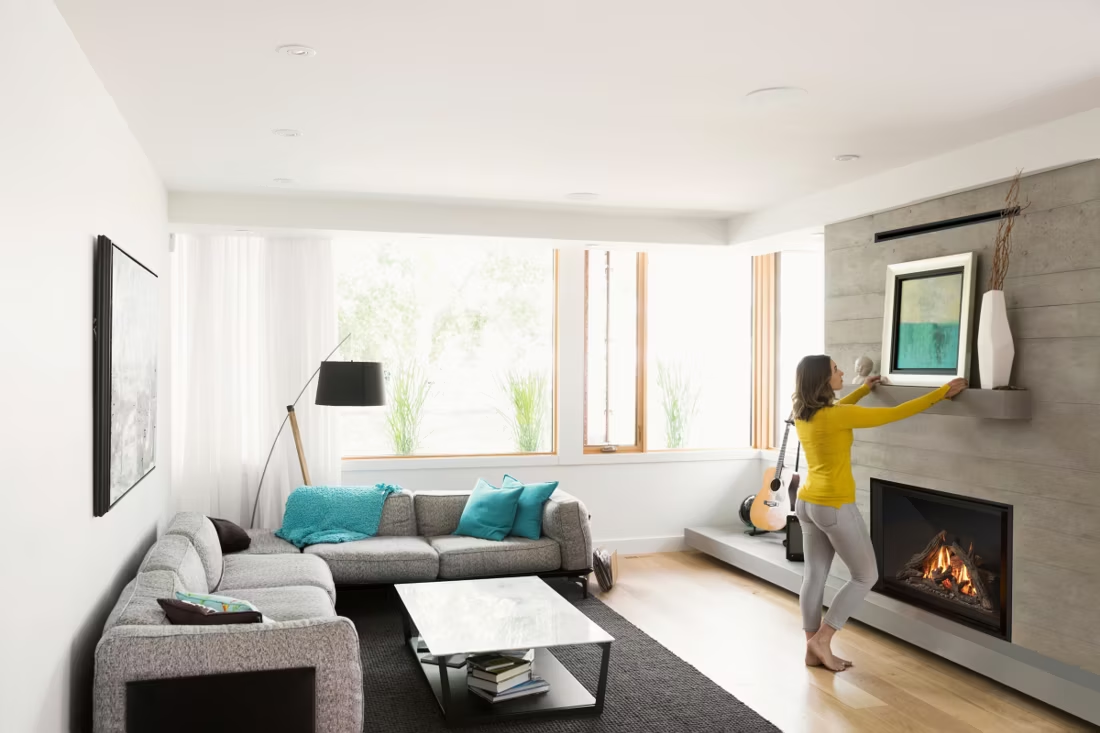
Riverside winters rarely dip below freezing, but cool Inland Empire evenings and South Coast AQMD's wood-burning restrictions make gas the fireplace of choice. Find the right unit and connect with a trusted local dealer.
Every Project Starts From One of These Five Situations
Built for mild Inland Empire winters, not deep freezes.
Riverside sits at 887 feet in the Inland Empire, where winter lows average a mild 43°F and the region logs only a light overall winter heating load each year—a fraction of what a place like Duluth, Minnesota racks up in a single hard winter. That mild Climate Zone 3B profile means wood heat has never taken hold here the way it has in the Sierra or the high desert; oak, madrone, and Douglas fir are around, but almost nobody in Riverside is burning them as a primary heat source. Gas fireplaces fill the gap instead—delivering real, on-demand warmth for the handful of genuinely cold nights each winter and the ambiance homeowners want in a living room or patio great room the rest of the year.
Riverside County sits in the South Coast Air Basin, one of the EPA's most persistent non-attainment areas, and it's also no stranger to wildfire smoke drifting in from the surrounding hills. The South Coast AQMD's Check Before You Burn program restricts wood-burning fireplaces on high-pollution days each winter, but gas fireplaces are exempt from those curtailments—a big part of why so many Riverside homeowners have converted old masonry fireboxes to gas. With electric rates from Southern California Edison running 28.25 cents per kWh (20.2 cents through City of Riverside Public Utilities in parts of town), gas heat is also the more efficient dollar-for-dollar choice for anyone who wants real BTUs out of the unit, not just ambiance.
Three steps. No salesperson until you're ready.
Tell us about your project
Your zip code, your situation, and the fuel you're leaning toward—or let the answers point you to one.
See what's actually available
The brands dealers within 100 miles genuinely carry—real options, never a catalog mirage.
Get your dealer & Project Guide
A trusted local dealer, plus the free Project Guide & Parts List that names every component of the job.
Frequently Asked Questions
How much does a gas fireplace installation cost in Riverside?
Most gas fireplace installations in Riverside run in the $3,500 to $9,000 range. A direct-vent gas insert dropped into an existing masonry firebox with a gas line already nearby sits at the lower end; a new built-in gas fireplace for a remodel or great-room addition—with framing, venting, and a fresh gas line—lands in the middle to upper end. Homes in unincorporated parts of Riverside County that need a new propane tank instead of natural gas service typically run higher. Local dealers will size the job and give you a firm number after seeing your fireplace or framing in person.
Can I convert my existing wood-burning fireplace to gas?
Yes, and it's one of the most common projects local hearth dealers see in Riverside. A lot of the tract homes built through the 1960s-80s came with a standard masonry wood fireplace that rarely gets used now, partly because South Coast AQMD's Check Before You Burn program restricts wood burning on high-pollution winter days across the basin. Converting that firebox to a gas insert with a liner run up the existing chimney typically costs $4,000 to $8,000 and gets you a fireplace you can light any night of the year without checking an air quality advisory first.
Do I need natural gas, or can I use propane?
Nearly all of the city of Riverside is served by natural gas through SoCalGas, so if your home already has a gas water heater, range, or furnace, adding a fireplace is a straightforward tap into the existing line. Some newer developments on the city's edges and unincorporated pockets of Riverside County run on propane instead. Either fuel works in most gas fireplace models—your installer just sets the correct orifice and regulator for whichever you have.
Will my gas fireplace work during a power outage?
Most modern gas fireplaces with intermittent pilot ignition (IPI) run on a battery backup that kicks in automatically when the power drops, so the fireplace lights on demand just like normal. That matters in Riverside, where Southern California Edison periodically calls Public Safety Power Shutoffs during high-wind wildfire risk and the power can be out for a day or more. Valor fireplaces take a different approach: the pilot's thermocouple generates the unit's own electricity, so there are no batteries to remember at all. Ask your local dealer about the ignition system on any model you're considering if outage backup matters to you.
What's the difference between a gas fireplace, gas insert, and gas stove?
A gas fireplace is a fully built-in unit framed into a wall—the right call for a new great room or a remodel without an existing firebox. A gas insert is sized to slide into an existing masonry fireplace opening, which describes a huge share of Riverside's older ranch and Spanish Revival homes. A gas stove is a freestanding cabinet unit that sits on the floor and vents out a wall or through the roof, useful in a room without any existing chimney. For most Riverside homeowners with a fireplace they've stopped using, an insert is the simplest upgrade.
Do I need a permit to install a gas fireplace in Riverside?
Yes. Inside city limits, the City of Riverside Building & Safety Division requires both a building permit and a gas line permit for a new gas fireplace or insert; in unincorporated parts of Riverside County, the County's Department of Building and Safety handles it. The gas line portion has to be run by a licensed gas-fitter, which is one reason it's worth using a hearth dealer who coordinates the venting, gas line, and inspection together instead of piecing it out to separate trades yourself.
What's the difference between vented and vent-free gas fireplaces?
Vented, direct-vent gas fireplaces pull combustion air from outside and exhaust the byproducts back outside through a sealed pipe—they're the standard choice everywhere, including Riverside. Vent-free (unvented) units burn gas directly into the room air, and California is one of the states that heavily restricts or prohibits them, particularly in bedrooms and in homes without specific ventilation provisions. Given the state rules and the South Coast Basin's existing air quality challenges, direct-vent units are what nearly every local dealer installs and recommends here.
How often should my gas fireplace be serviced?
Plan on an annual inspection, ideally in early fall before you start using it for the season. A technician checks the burner, pilot assembly, venting, and gas connections, and cleans the glass and interior. It's a lighter lift than chimney sweeping for a wood-burning unit, but skipping it is how pilot and ignition problems go undetected. Local gas appliance service providers in Riverside typically charge $150 to $250 for the visit.
Gas vs. wood vs. electric—which fireplace makes sense in Riverside?
Wood is genuinely rare here—Riverside's mild 43°F average winter low and South Coast AQMD's burn-day restrictions mean almost nobody relies on a wood stove for real heat, even though cutting permits for oak and Douglas fir are available through the San Bernardino and Angeles National Forests for the rare cabin or camp use. Electric fireplaces are simple to install (often under $1,000, no venting required) and popular for rentals or supplemental rooms, but at Southern California Edison's 28.25 cents per kWh, they're the most expensive way to actually produce heat. Gas splits the difference: real BTUs, instant on-off, no burn-day restrictions, and a lower cost per hour of heat than electric resistance. For most Riverside living rooms, gas is the practical choice.
Can I put a TV above my fireplace?
Yes—with an asterisk. Fireplaces are hot and TVs don't like heat. Either put a mantel between them to deflect rising warmth, or choose a fireplace with heat-management technology that creates a cool zone on the wall above—the wall stays around 125 degrees, barely warm, while the room still gets full heat. If you like clean lines and don't want a mantel, heat management is the answer.
Why is a fireplace insert so efficient?
An insert does two things: it seals the chimney completely, so you stop losing air you already paid to heat, and it radiates warmth into the room through the firebox and glass. Most add a heat-exchange fan that pulls cool room air underneath, wraps it around the hot firebox, and pushes it back out warm. Your home is more efficient before you've even lit the first fire.
Does a fireplace add value to my home?
On average, a fireplace adds back to the home about the same amount you spent installing it. Add the monthly savings from heating the rooms you actually use instead of the whole house—often hundreds of dollars a year—and the value case is strong before you even count what a fire does for how your family uses the room.
How much should I budget for a fireplace?
For an average home—covering the fireplace, the vent pipe, and basic installation—a budget between $3,900 and $5,500 gives you a lot of options across wood, gas, and pellet. By the time you add finish work, gas line, and electrical, the average complete installation lands between $5,000 and $12,000 all-in. In a remodel or new build, a good rule is to put about 2.5% of the total project cost toward the fireplace.
Nearby Dealers
Hearth shops serving Riverside and the surrounding area. Every listing shows whether it is a WhyFire partner, a dealer we have verified as authorized for the brands we recommend, or a local business carrying hearth products. No manufacturer pays for placement. How we verify dealers →
Best Of Backyard
Patio World
Innovative Masonry Solutions
West End Brick N' Fire
Patio Furniture Plus Outdoor Living
Quality Marble & Granite
Resource Building Materials
Ye Olde Brit Chimney Sweep
Bbq Grill Outlet
Terra Outdoor Living
Hemet Fireplace
Patio World
Hanks Hardware
Fireplace Door Guy
Whitewater Rock & Supply Co
Palm Springs True Value Hardware & Patio
The Patio Place
The Light House
The Fire Place
Sunrise Patios
All Valley Bbq, Spa & Fireplace
Outdoor Living Concepts
Find your gas fireplace in Riverside.
Tell us a bit about your home and we'll match you with a trusted local Riverside dealer and send over a free Project Guide & Parts List—the exact parts, including the vent kit, for your gas fireplace project.
Find Your Fireplace →