
Find your fireplace, from Port Hardy to Zeballos.
Wood, gas, pellet, and electric fireplace resources across the Regional District of Mount Waddington—from the working ports of Port Hardy and Port McNeill out to Alert Bay, Sointula, and the remote inlets past Woss. Tell us your project and we'll match you with a local dealer who actually services your community.
Every Project Starts From One of These Five Situations
Mild, wet winters and a region spread across working ports, islands, and inlets.
The Regional District of Mount Waddington covers the northern tip of Vancouver Island and a stretch of mainland inlets, home to roughly 6,136 people spread across Port Hardy, Port McNeill, Port Alice, Alert Bay, Sointula, Coal Harbour, Woss, Zeballos, and Tahsis. Classified climate zone 5C, winters here average lows near 1.8°C—a far cry from the deep freezes of Prince George three hundred kilometres east or the prairie cold of Edmonton. What defines a Mount Waddington winter isn't temperature so much as duration and damp: a long, grey heating season that runs from October well into April, with persistent rain and coastal humidity that makes a home feel colder than the thermometer suggests. Douglas fir, paper birch, lodgepole pine, and western larch are the wood species locals burn, much of it cut under personal-use permits through FrontCounter BC and the BC Ministry of Forests.
Air quality here follows a familiar BC pattern: the interior valleys around Woss and the Nimpkish drainage see winter inversions and occasional smoke advisories, which is why CSA or EPA-certified appliances are the standard for any new wood stove or insert, and why a wood-stove exchange program has circulated through the region in past years. Natural gas service reaches the larger hubs along the Island Highway corridor, while more remote communities—Alert Bay and Sointula by ferry, Zeballos and Tahsis by gravel logging road—typically run on propane instead. Any solid-fuel installation falls under the CSA B365 code, and most insurers ask for a WETT inspection before they'll write a policy on a home with a wood appliance. This hub rolls up hearth retailers, service technicians, and fuel suppliers across the whole region—pick your fuel below for local dealers and the numbers specific to your town.
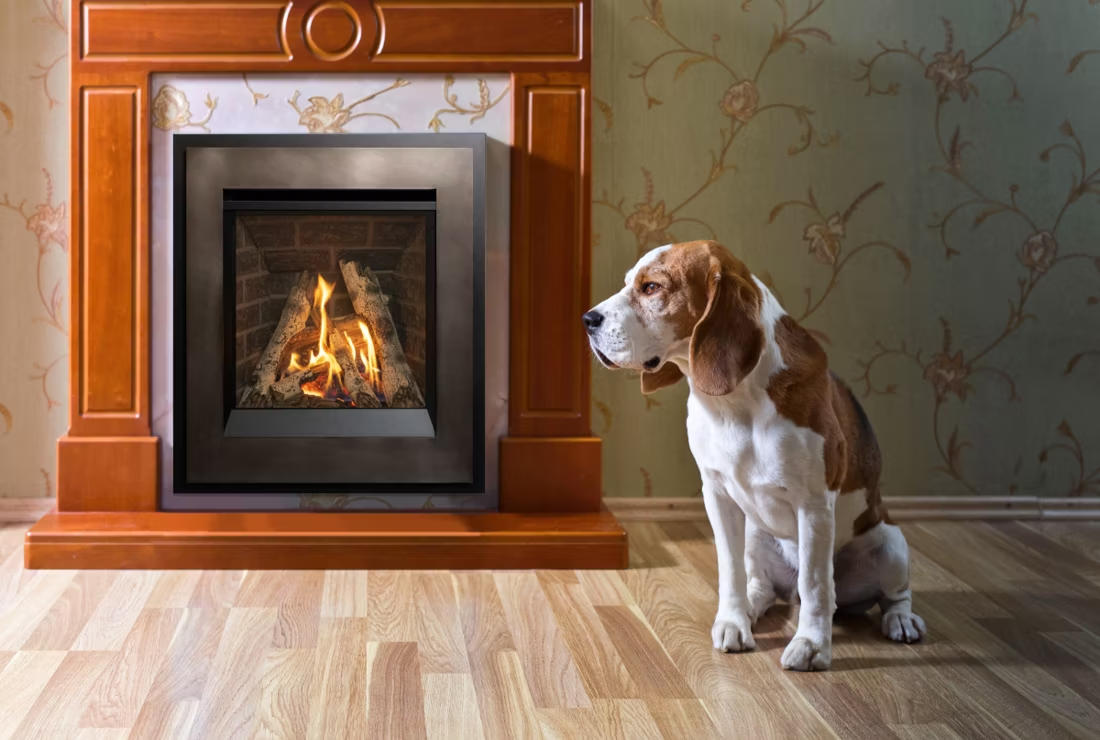
Four fuels. One honest answer for Regional District of Mount Waddington.
Wood
54 models available near Regional District of Mount Waddington.
Find your wood stove →Gas
104 models available near Regional District of Mount Waddington.
Find your gas fireplace →Pellet
See what's available near Regional District of Mount Waddington.
Find your pellet stove →Electric
See what's available near Regional District of Mount Waddington.
Find your electric fireplace →Three steps. No salesperson until you're ready.
Tell us about your project
Your postal code, your situation, and the fuel you're leaning toward—or let the answers point you to one.
See what's actually available
The brands dealers within 100 miles genuinely carry—real options, never a catalog mirage.
Get your dealer & Project Guide
A trusted local dealer, plus the free Project Guide & Parts List that names every component of the job.
Frequently Asked Questions
Which fireplace fuel makes the most sense in the Regional District of Mount Waddington?
All four fuels show up here, but which one fits depends on your site and your tolerance for damp cold. Wood is still the backbone fuel in outlying communities—Douglas fir, paper birch, lodgepole pine, and western larch are all common species, and a lot of households cut their own under a FrontCounter BC personal-use permit. Because Mount Waddington's average winter low sits around 1.8°C rather than deep freeze territory, the challenge isn't holding a fire through minus-thirty overnight lows like you'd need in Prince George—it's fighting persistent humidity, so a stove with strong secondary combustion and a properly sized, well-insulated flue matters more than sheer output. Gas is the low-maintenance choice where mains service reaches, mainly Port Hardy and Port McNeill; most other communities run propane. Pellet stoves have a following too, with Pinnacle Premium and Princeton Fuel Pellets both distributed regionally, and they handle coastal humidity well since the fuel itself is kiln-dried and consistent. Electric fireplaces are supplemental here—useful in a guest cabin, a bedroom, or a room that just needs ambiance—since even a heating season this mild doesn't call for a plug-in unit as primary heat.
Do I need a permit or inspection to install a wood stove here?
Yes. Any solid-fuel appliance—wood stove, insert, or fireplace—falls under the CSA B365 installation code, and it needs to be CSA or EPA-certified, which matters here because the Woss and Nimpkish valley areas see winter inversions that trigger smoke advisories some years. Building permits go through whichever municipal building department covers your address: Port Hardy, Port McNeill, Port Alice, and Alert Bay each run their own, while unincorporated communities like Coal Harbour, Winter Harbour, and Quatsino permit directly through the Regional District. On top of the building permit, most home insurers require a WETT inspection before they'll write or renew a policy on a house with a wood-burning appliance, so budget for that step even if your municipality doesn't flag it separately. Gas installs need a licensed gas fitter and a separate gas permit; electric fireplaces usually only need a permit if you're adding a new circuit.
Is natural gas actually available in this region?
It depends on where in the region you are. Mains natural gas reaches the larger population centers along the Island Highway corridor—Port Hardy and Port McNeill in particular—so a gas fireplace or insert there is a straightforward hookup. Communities that sit off that corridor, including Alert Bay and Sointula (both reached by BC Ferries) and Zeballos and Tahsis (reached by gravel logging road), typically don't have mains service, and homeowners there run gas appliances on delivered or bottled propane instead. Functionally the appliance and the flame look the same either way; the difference is just how the fuel gets to your tank, and your local dealer will know which supply option applies to your street before you commit to a unit.
Can one retailer carry more than one fuel type?
Most retailers serving this region carry two or three fuel types rather than specializing in one, which makes sense given how spread out the communities are and how differently each one is fueled. A multi-fuel dealer based in Port Hardy or Port McNeill can walk you through wood, gas, and pellet options side by side and tell you honestly which one fits your particular street—whether that's mains gas, propane delivery, or a good crown-land wood permit. We match you with the retailer whose fuel lineup and service area genuinely covers your community, not whichever dealer happens to be biggest.
How does service work for the more remote communities like Alert Bay, Zeballos, or Tahsis?
Service crews are based mostly in Port Hardy and Port McNeill, and they travel out on a schedule rather than on demand—Alert Bay and Sointula require a ferry crossing, and Zeballos, Tahsis, and Woss are reached by gravel logging roads that can close temporarily during heavy weather. Expect a modest travel surcharge for the farthest appointments, and book your annual chimney sweep, WETT inspection, or gas check in late summer, well before fall storm season starts stacking up ferry cancellations and road closures. If you're on a genuinely remote property, ask your installer about spare igniter parts or a backup plan for your gas fireplace, since a delayed ferry or a washed-out logging road can push a repair visit back by several days.
What does a fireplace installation typically cost in this region?
Costs vary by fuel and by how much venting or gas-line work your home needs. A wood stove or insert install typically runs $4,500 to $9,000 CAD, more if you need new chimney work from scratch. Gas fireplaces, inserts, and stoves generally land between $5,000 and $11,000, with the low end for a simple insert conversion and the high end for a new gas line run to an outbuilding or addition. Pellet stove installs usually fall in the $4,500 to $7,500 range. Electric fireplaces are the exception—$200 to $3,000 for the unit itself, plus $400 to $1,200 in labor for anything beyond a straightforward plug-in placement. Homes in the more remote communities should budget a little extra for technician travel time, which your local dealer will fold into the quote up front.
How many BTUs do I need in a fireplace?
Wrong question—and the industry's favorite way to confuse you. More BTUs isn't better if the fireplace cooks you out of the room you spent thousands to enjoy. Think in terms you can verify: how many square feet the unit heats, whether it's primary or backup heat, and whether you want it running overnight. Those three answers size a fireplace correctly every time.
Will we actually use a fireplace once we have one?
In my own home, the room with the fireplace has never been the same—it became the social hub. Game nights, holidays, date nights after the kids are down: the fire is where the house gathers. There's a reason people in this industry joke that we're really in the romance and entertainment business. You won't wonder whether you'll use it; you'll wonder how the room worked before.
What's the difference between an insert and a zero-clearance fireplace?
An insert is a fireplace that slides into a pre-existing wood-burning fireplace—if you don't have one, there's nothing to insert it into. A zero-clearance fireplace is built into a framed wall, which makes it the answer for remodels and new construction. Simple test: existing masonry fireplace means insert; blank or framed wall means zero-clearance.
Can I put a TV above my fireplace?
Yes—with an asterisk. Fireplaces are hot and TVs don't like heat. Either put a mantel between them to deflect rising warmth, or choose a fireplace with heat-management technology that creates a cool zone on the wall above—the wall stays around 125 degrees, barely warm, while the room still gets full heat. If you like clean lines and don't want a mantel, heat management is the answer.
Stove and Fireplace Dealers in Regional District of Mount Waddington
Listings include WhyFire partner dealers, dealers we have verified as authorized for the brands we recommend, and established local businesses that carry hearth products. Every listing shows which one it is. The ones marked Preferred run on WhyFire's software, so they can show you real pricing and book your appointment right here. No manufacturer pays for placement. How we verify dealers →
Shop Rite
Sunco Plywood Sales
Builders Warehouse
Get matched with a local Mount Waddington dealer.
Pick your fuel below and we'll put together a free Project Guide & Parts List—the right unit, the vent kit it needs, and the local dealer we recommend for your project, wherever along the coast you are.
Find Your Fireplace →