
Find your fireplace across Kitimat-Stikine.
Wood, gas, pellet, and electric fireplace resources for the whole region—from the port at Kitimat and the Skeena valley around Terrace up through the Hazeltons, Stewart, and the far north near Dease Lake. Pick a fuel and get matched with a local dealer who actually works in your community.
Every Project Starts From One of These Five Situations
One region, two climates, and four fuels that all genuinely work here.
The Regional District of Kitimat-Stikine stretches from the tidewater industrial port of Kitimat and the Skeena valley trading hub of Terrace north through Kitwanga and the Hazeltons, then further still to Stewart near the Alaska panhandle and Dease Lake close to the Yukon border. Average winter lows near -4.4°C reflect the coastal moderation Terrace and Kitimat get from the Douglas Channel, but conditions turn considerably harder heading north and inland—Dease Lake and Iskut winters run closer to what Whitehorse sees than to the valley floor around Terrace. Douglas fir, paper birch, lodgepole pine, and western larch are the species local households burn, drawn from the mixed coastal-interior forest that defines the Skeena watershed.
Interior valleys here trap cold air and smoke during winter inversions, which is why several communities in this region run wood-stove exchange programs and require CSA/EPA-certified appliances rather than older uncertified units. Natural gas service through Pacific Northern Gas reaches the Terrace-Kitimat corridor, making gas a mainstream option in town, though it thins out fast heading toward Stewart, the Hazeltons, and Dease Lake, where propane and wood carry more of the heating load. This hub rolls up hearth retailers, service technicians, and fuel suppliers across the whole region. Pick your fuel below for local dealers, install costs, and unit recommendations specific to your community.
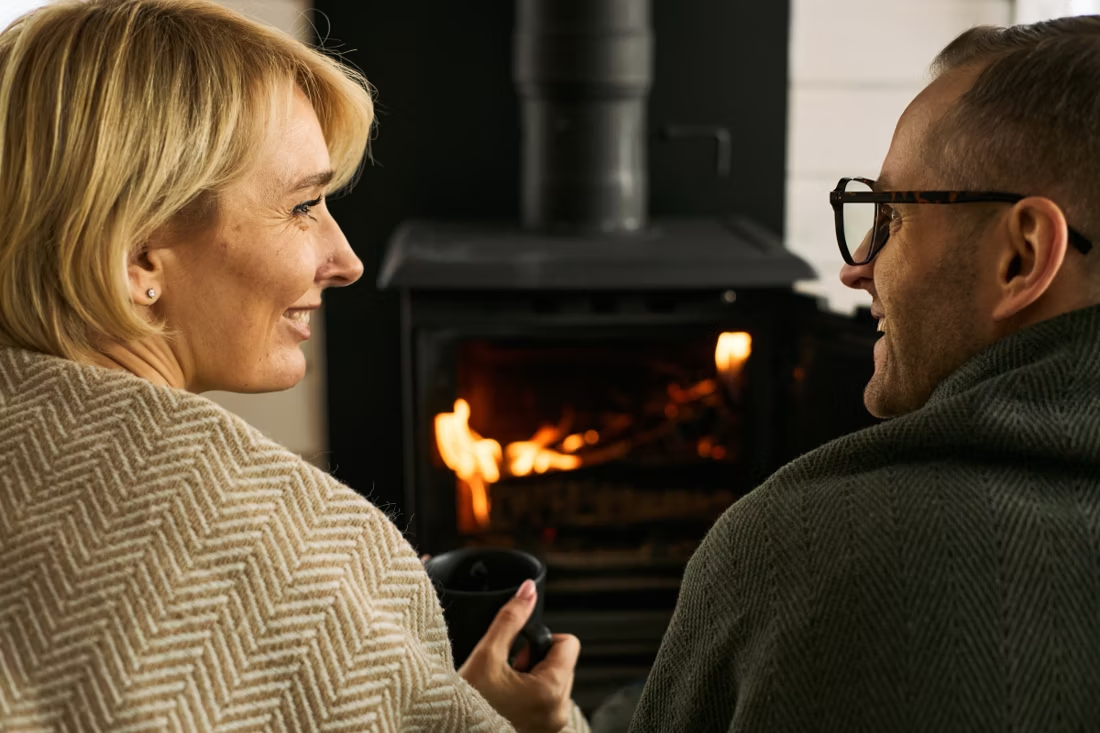
Four fuels. One honest answer for Regional District of Kitimat-Stikine.
Wood
69 models available near Regional District of Kitimat-Stikine.
Find your wood stove →Gas
104 models available near Regional District of Kitimat-Stikine.
Find your gas fireplace →Pellet
See what's available near Regional District of Kitimat-Stikine.
Find your pellet stove →Electric
See what's available near Regional District of Kitimat-Stikine.
Find your electric fireplace →Three steps. No salesperson until you're ready.
Tell us about your project
Your postal code, your situation, and the fuel you're leaning toward—or let the answers point you to one.
See what's actually available
The brands dealers within 100 miles genuinely carry—real options, never a catalog mirage.
Get your dealer & Project Guide
A trusted local dealer, plus the free Project Guide & Parts List that names every component of the job.
Frequently Asked Questions
Which fireplace fuel makes the most sense across Kitimat-Stikine?
It depends heavily on where you sit in the region. Wood is the backbone fuel almost everywhere—Douglas fir, paper birch, lodgepole pine, and western larch are all common locally, and a CSA/EPA-certified stove burning any of them holds a fire through the region's cold snaps without trouble. Gas is genuinely mainstream in and around Terrace and Kitimat, where Pacific Northern Gas reaches most neighbourhoods; further out toward Stewart, the Hazeltons, or Dease Lake, gas usually means a propane tank rather than a mains hookup. Pellet stoves have a solid following region-wide, with Pinnacle Premium and Princeton Fuel Pellets both distributed locally and pellet units exempt from the burning restrictions some communities apply during smoke advisories. Electric fireplaces work well as supplemental heat or ambiance in a home that's already primarily heated by wood or gas, but they're not sized to carry a northern winter on their own.
Do I need a permit or inspection to install a wood stove here?
Yes. Installation permits go through your municipal building department—Terrace, Kitimat, and Stewart each handle their own—and any new install has to meet the CSA B365 installation code. Most insurance providers in this region also require a WETT inspection before they'll cover a wood-burning appliance, so budget for that as part of the project even if your municipality doesn't formally require it. Gas installs need a licensed gas fitter and a separate gas-line permit. Pellet stoves follow a similar permitting path to wood but without the same insurance scrutiny. The dealer you're matched with typically handles the permitting and WETT paperwork as part of the project, so it's not something you're chasing down alone.
What are the smoke advisories and wood-stove exchange programs I've heard about?
Interior valleys around Terrace and the Hazeltons trap cold air and wood smoke on still winter days, the same way Prince George's valley does further south, and local air quality officials issue smoke advisories when conditions get bad enough. Several communities in this region run wood-stove exchange programs that offer an incentive to retire an old, uncertified stove for a new CSA/EPA-certified unit, which burns dramatically cleaner and produces less visible smoke on inversion days. If you're buying or upgrading a wood stove here, certification isn't optional paperwork—it's the difference between an appliance that can burn freely and one that draws complaints from neighbours during an advisory.
Is natural gas actually available where I live in this region?
It depends on the community. Pacific Northern Gas runs mains service through the Terrace-Kitimat corridor, so a straightforward gas fireplace or insert hookup is realistic for most homes in those two towns. Once you're out toward Kitwanga, the Hazeltons, Stewart, or north to Dease Lake and Iskut, mains gas generally isn't there, and a gas fireplace means running on a propane tank instead—still a workable option, just with a different fuel-supply plan and tank placement to sort out with your dealer. Checking availability at your specific address before you fall in love with a particular gas unit is worth the five-minute call.
How does installation and service work across such a spread-out region?
Most retailers and service technicians are based in Terrace or Kitimat, where the population and the bulk of the work is, and they travel out to Kitwanga, the Hazeltons, and Stewart on a regular basis—expect a trip fee for the farther calls. Dease Lake and Iskut are far enough north that scheduling takes real lead time, so if you're up there, book your annual chimney sweep or gas inspection well before the first hard freeze rather than waiting for a problem. For remote properties, it's worth asking your dealer about spare igniter parts or a backup plan for wood heat, since a winter storm can delay a return service call by several days on those roads.
What does a fireplace installation typically cost in this region?
Costs shift with fuel type and how much venting or gas-line work your home needs. Wood stove or insert installs typically run $4,000-$8,500 CAD, with a full masonry chimney for new construction pushing higher once WETT inspection and CSA B365 compliance are factored in. Gas fireplaces, inserts, and stoves generally run $4,000-$10,000, more if you're extending a gas line or converting from propane to mains service in Terrace or Kitimat. Pellet stove and insert installs usually land around $4,000-$7,000. Electric fireplaces are the outlier—$200-$3,000 for the unit itself, plus a few hundred dollars in labour for anything beyond a simple plug-in placement. The region and fuel pages above break these numbers down further with local retailer pricing.
How many BTUs do I need in a fireplace?
Wrong question—and the industry's favorite way to confuse you. More BTUs isn't better if the fireplace cooks you out of the room you spent thousands to enjoy. Think in terms you can verify: how many square feet the unit heats, whether it's primary or backup heat, and whether you want it running overnight. Those three answers size a fireplace correctly every time.
Will we actually use a fireplace once we have one?
In my own home, the room with the fireplace has never been the same—it became the social hub. Game nights, holidays, date nights after the kids are down: the fire is where the house gathers. There's a reason people in this industry joke that we're really in the romance and entertainment business. You won't wonder whether you'll use it; you'll wonder how the room worked before.
How much should I budget for a fireplace?
For an average home—covering the fireplace, the vent pipe, and basic installation—a budget between $3,900 and $5,500 gives you a lot of options across wood, gas, and pellet. By the time you add finish work, gas line, and electrical, the average complete installation lands between $5,000 and $12,000 all-in. In a remodel or new build, a good rule is to put about 2.5% of the total project cost toward the fireplace.
Can a fireplace actually lower my heating bill?
Yes—by creating a comfort zone. A furnace heats every square foot of the house just to warm the one room you're in; a gas fireplace on low burns roughly a sixth of the gas a typical furnace does. Set the furnace around 55–60 degrees as a baseline, then heat the rooms your family actually uses. Families who heat this way commonly save $20–$60 a month.
Stove and Fireplace Dealers in Regional District of Kitimat-Stikine
Listings include WhyFire partner dealers, dealers we have verified as authorized for the brands we recommend, and established local businesses that carry hearth products. Every listing shows which one it is. The ones marked Preferred run on WhyFire's software, so they can show you real pricing and book your appointment right here. No manufacturer pays for placement. How we verify dealers →
Aqua Plumbing & Heating Ltd.
Get matched with a local Kitimat-Stikine dealer.
Pick your fuel below and we'll put together a free Project Guide & Parts List—the right unit, the vent kit it needs, and the local dealer we recommend for your project in Kitimat-Stikine.
Find Your Fireplace →