
Find the Right Fireplace for Your Ozark Hill Country Home.
Wood, gas, pellet, and electric fireplace resources for Jasper, Ponca, Mount Judea, Western Grove, and every hollow and ridge in Newton County. Find the right unit for your home and connect with a trusted local hearth retailer.
Every Project Starts From One of These Five Situations
Wood heat in the heart of the Ozarks.
Newton County sits deep in the Boston Mountains of the Ozarks, with the Buffalo National River cutting through the northern half of the county and the Ozark-St. Francis National Forest covering much of the rest. This is oak, hickory, and pine country—thick hardwood timber that's heated homes here for generations. With a population under 2,000 spread across a county with no incorporated city larger than Jasper, homes here tend to be rural, often on acreage, and often without access to a natural gas main. Propane and wood remain the practical heating backbone for most of the county.
What you'll find on this hub: hearth retailers, service technicians, and fuel suppliers covering Newton County's towns and unincorporated communities—from Jasper and Ponca along the Buffalo River corridor to Mount Judea, Western Grove, Fallsville, and Compton. Pick your fuel below to see local dealers, typical installation costs, and the units that make sense for a Zone 4A winter in the Ozark hills. Whether you're heating a farmhouse outside Jasper or a cabin near the elk range on Highway 43, this is the starting point.
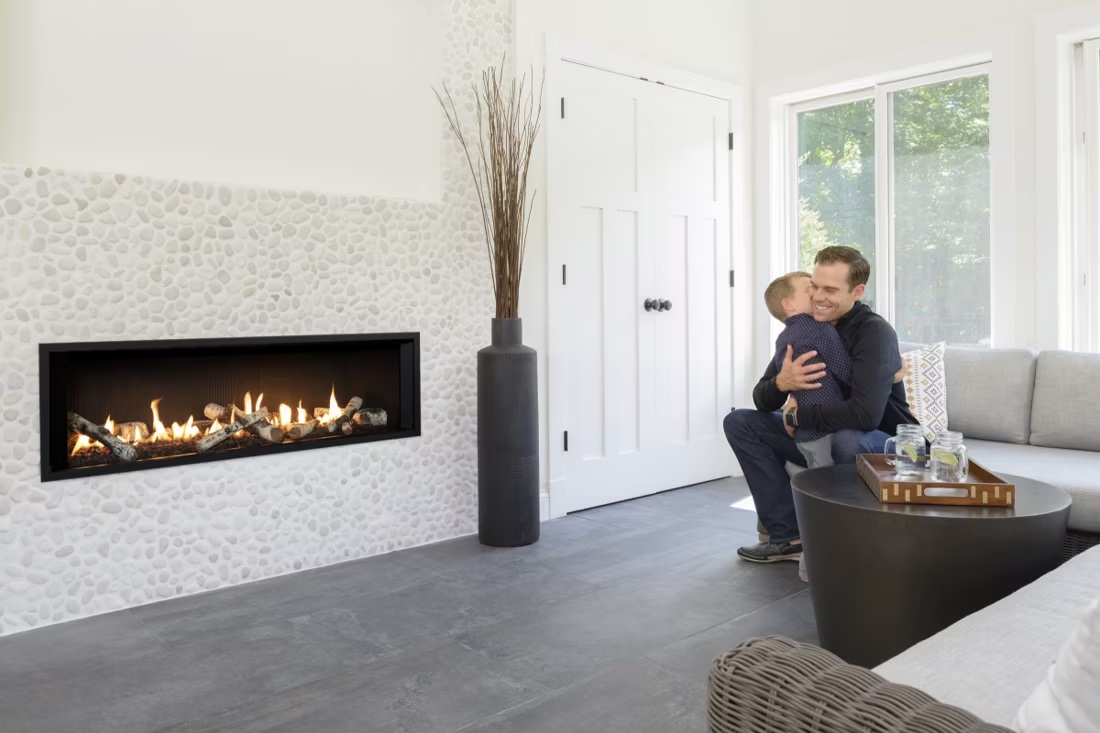
Four fuels. One honest answer for Newton County.
Three steps. No salesperson until you're ready.
Tell us about your project
Your zip code, your situation, and the fuel you're leaning toward—or let the answers point you to one.
See what's actually available
The brands dealers within 100 miles genuinely carry—real options, never a catalog mirage.
Get your dealer & Project Guide
A trusted local dealer, plus the free Project Guide & Parts List that names every component of the job.
Frequently Asked Questions
Which fuel works best in Newton County?
It depends on what's already at your property and how remote you are. Wood is the traditional choice here—oak and hickory are the dominant local species, split and seasoned firewood is cheap or free if you're cutting on your own land or under an Ozark-St. Francis National Forest permit, and a good wood stove keeps a home warm through a Zone 4A winter without relying on any utility. Gas, in practice, usually means propane rather than natural gas—most of the county has no gas main, so a propane fireplace or insert with a buried or above-ground tank is the realistic 'gas' option, and it gives you instant heat without hauling wood. Pellet stoves are a solid middle ground if you want wood-style ambiance with less daily labor, though pellet bags have to be trucked in since there's no local mill—Lignetics is a common regional brand. Electric fireplaces work well as supplemental heat for a bedroom or den, but given how many Newton County homes are off natural gas entirely, electric alone isn't typically the primary heat source. Many households here run wood or propane as primary heat with a secondary unit for convenience.
Do I need a permit to install a fireplace in Newton County?
It varies more here than in a city. Newton County does not have a county-wide building code enforcing permits the way many suburban counties do, and outside the small footprint of Jasper you may not need a formal building permit for a wood stove or insert installation. That said, manufacturer installation instructions, NFPA 211 clearance requirements, and your homeowner's insurance carrier's expectations still apply regardless of local permitting—an install that doesn't meet code can affect a claim after the fact. Propane installations should still go through a licensed propane provider for the tank set and gas connection, since that work involves pressure testing and leak checks that matter for safety. If you're inside Jasper's city limits, check with the city before you install. Most local hearth retailers who serve this county are used to navigating that patchwork and can tell you exactly what applies to your address.
Does Newton County have wood-burning restrictions or air quality rules?
No. Newton County isn't in an EPA non-attainment area and doesn't have winter burn bans or curtailment periods like some western counties do. That's typical for this part of the Ozarks—low population density and steady air movement through the hollows mean smoke doesn't accumulate the way it can in a basin. That said, if you're installing a new wood stove, it still needs to meet EPA 2020 NSPS emissions standards as a matter of federal manufacturing law, regardless of local air quality rules—most stoves sold by hearth retailers today already comply.
Can one local hearth retailer handle all four fuel types out here?
Some can, but expect more variation than you'd see in a bigger market. Because Newton County itself has no large town, most retailers serving the area are based 30-45 minutes out—in Harrison, Marshall, or further toward Fayetteville—and their fuel mix depends on what sells in their home market. Dealers who serve a lot of rural acreage tend to carry strong wood and propane lines since that's what most Newton County homes actually run. Pellet and electric are usually available too, but as a smaller part of the showroom. If you want to compare fuels side by side, ask up front which units a dealer keeps on the floor versus what they'd need to special-order—it affects your timeline.
How does installation and service work when you're this far out?
Plan for a longer lead time than you would in a suburban county. Because dealers and technicians are commuting in from Harrison, Marshall, or beyond, a travel charge for rural stops is common, and scheduling around Buffalo River tourist season (spring and fall float trips) can add a few days either way. Wood stove and chimney work is generally easier to schedule locally since it doesn't depend on a specific gas line crew. Propane installs need coordination between your propane supplier and the hearth installer for the tank set and connection. If you're heating a cabin near Ponca or a homestead off a gravel road, book your fall service call early—August or September—before the rush that hits everyone else in October.
What's the typical cost range for fireplace installation across all fuel types in Newton County?
Costs run close to regional Ozark norms, with rural travel sometimes adding to the total. Wood stove or insert installation: roughly $3,500-$8,000 depending on chimney work, with self-cut oak or hickory keeping ongoing fuel costs near zero if you have forest access or your own timber. Propane fireplace, insert, or stove: roughly $4,000-$9,500, including the appliance, venting, and connection to an existing or new propane tank. Pellet stove or insert: roughly $4,000-$7,000 for a typical install, with pellets trucked in since there's no local mill. Electric fireplace: $200-$3,000 for the unit itself, plus $400-$1,000 in labor for anything beyond a simple plug-in unit. See the county + fuel pages above for cost detail tied to specific dealers.
What is an in-home preview and do I need one?
It's a visit where a hearth professional measures your space, confirms the model you picked actually works in your home, and walks the specs—framing, gas line, venting, finish work—before anything is ordered. Some details you just can't know until you see the house. Never make a down payment without one; it's the single most-skipped step that burns buyers.
Can a fireplace actually lower my heating bill?
Yes—by creating a comfort zone. A furnace heats every square foot of the house just to warm the one room you're in; a gas fireplace on low burns roughly a sixth of the gas a typical furnace does. Set the furnace around 55–60 degrees as a baseline, then heat the rooms your family actually uses. Families who heat this way commonly save $20–$60 a month.
How much should I budget for a fireplace?
For an average home—covering the fireplace, the vent pipe, and basic installation—a budget between $3,900 and $5,500 gives you a lot of options across wood, gas, and pellet. By the time you add finish work, gas line, and electrical, the average complete installation lands between $5,000 and $12,000 all-in. In a remodel or new build, a good rule is to put about 2.5% of the total project cost toward the fireplace.
Does a fireplace add value to my home?
On average, a fireplace adds back to the home about the same amount you spent installing it. Add the monthly savings from heating the rooms you actually use instead of the whole house—often hundreds of dollars a year—and the value case is strong before you even count what a fire does for how your family uses the room.
Stove and Fireplace Dealers in Newton County
Listings include WhyFire partner dealers, dealers we have verified as authorized for the brands we recommend, and established local businesses that carry hearth products. Every listing shows which one it is. The ones marked Preferred run on WhyFire's software, so they can show you real pricing and book your appointment right here. No manufacturer pays for placement. How we verify dealers →
Pioneer Propane Gas
Pcs Fireplace & Patio & Professional Chimney Services
Professional Chimney Services
Abc Block And Brick
Find your fireplace in Newton County.
Pick your fuel below and we'll match you with a trusted local dealer plus a free Project Guide & Parts List—the exact parts, vent kit included, and the dealer we recommend for your Newton County project.
Find Your Fireplace →