
Instant heat for a foothills town that averages -15.7°C.
At 982 metres in the foothills west of Red Deer, Rocky Mountain House sees a long, genuinely cold season. We'll help you find a trusted local dealer who knows the ATCO Gas and Apex Utilities service areas and can spec a system sized for your home.
Every Project Starts From One of These Five Situations
Heat that doesn't depend on a woodpile or a Chinook.
Rocky Mountain House sits in Climate Zone 7B at 982 metres, with winter lows averaging -15.7°C and a heating season that stretches from October well into April—closer in character to Edmonton or Prince George than to the milder river valleys further south. The Chinook belt brings sudden freeze-thaw swings through the winter, which is convenient for driveways but hard on firewood seasoning and tight rural supply, since cordwood needs a full dry season before it burns clean. A gas fireplace sidesteps that logistics problem entirely: turn a switch, get heat, no stack of aspen poplar or lodgepole pine to manage.
Natural gas service through ATCO Gas and Apex Utilities reaches most of Rocky Mountain House, so a straightforward tie-in is realistic for the majority of homes in town. Installed systems typically run $6,000 to $15,000 CAD depending on whether you're inserting into an existing firebox or running new gas line and venting for a build. Every installation goes through the municipal building department and follows the CSA B365 installation code, and most local dealers who work this area handle that permitting as part of the job rather than leaving you to coordinate it.
Three steps. No salesperson until you're ready.
Tell us about your project
Your postal code, your situation, and the fuel you're leaning toward—or let the answers point you to one.
See what's actually available
The brands dealers within 100 miles genuinely carry—real options, never a catalog mirage.
Get your dealer & Project Guide
A trusted local dealer, plus the free Project Guide & Parts List that names every component of the job.
Frequently Asked Questions
How much does a gas fireplace installation cost in Rocky Mountain House?
Expect $6,000 to $15,000 CAD for a typical installation. A direct-vent insert dropping into an existing masonry firebox on an already-serviced ATCO Gas or Apex Utilities line sits toward the low end. A new built-in unit for an addition or garage build-out, requiring a fresh gas line run and wall or roof venting, lands toward the top. Rural properties just outside town limits that aren't on either utility's mains should budget for a propane tank set on top of the install cost.
Can I convert my existing wood fireplace to gas?
Yes, and it's a common upgrade here. A gas insert typically slides into the existing masonry firebox with a liner run through the current chimney, generally in the $6,000-$9,500 range depending on gas line access. It also sidesteps an ongoing cost of wood ownership in this area: insurers commonly require a WETT inspection on active wood appliances, and that requirement goes away once the appliance is gas. If your fireplace has sat unused because splitting and seasoning aspen poplar or paper birch isn't practical anymore, conversion is usually the simplest fix.
Is natural gas available at my address, or do I need propane?
Most of Rocky Mountain House is served by either ATCO Gas or Apex Utilities, so a natural gas tie-in is realistic for the majority of in-town addresses. Properties out along the highway corridors or on acreages beyond the serviced grid typically run on propane instead, with a tank sized to the appliance. Either way, most fireplace lines your local dealer carries can be configured for natural gas or propane, so fuel type shouldn't limit which model you choose.
Will a gas fireplace still work if the power goes out?
Most will, which matters given how winter wind events and Chinook-driven weather swings can knock out rural power in this area. Units with intermittent pilot ignition run on a AA battery backup that kicks in automatically when the grid drops. Some models, including several from Valor, skip the battery altogether because their pilot's thermocouple generates its own current. Ask your dealer which ignition system is on any unit you're considering if outage resilience matters to you.
What's the difference between a gas fireplace, insert, and stove?
A gas fireplace is a built-in unit framed into a wall, the standard choice for new construction or a full renovation. A gas insert fits into an existing masonry firebox, which is the common retrofit in older Rocky Mountain House homes that started out burning local lodgepole pine or white spruce. A gas stove is freestanding on a hearth pad, similar in footprint to a wood stove but running on a gas line or propane tank instead of cordwood. For most existing homes here, an insert is the least disruptive option since it reuses the chimney chase you already have.
Do I need a permit to install a gas fireplace in Rocky Mountain House?
Yes. Installations go through the municipal building department and must meet the CSA B365 installation code, with the gas line work itself done by a licensed gas fitter. Most local hearth dealers coordinate both the building permit and the gas hookup as part of the project, and they'll arrange the final inspection so you're not managing two separate trades on your own.
Should I go with a direct-vent or vent-free gas fireplace here?
Direct-vent is the standard recommendation for Rocky Mountain House and most local dealers will steer you there by default. It pulls combustion air from outside and exhausts it back outside through sealed venting, which holds up better through a long, genuinely cold season than a vent-free unit that burns into the room. At 982 metres of elevation, appliance sizing and venting also need to account for altitude, which is exactly the kind of detail a manufacturer-authorized local dealer checks before ordering parts.
How often does a gas fireplace need to be serviced?
Plan on an annual check, ideally in late summer or early fall before the first real cold snap rather than mid-winter when technicians are booked solid. A service visit covers the burner, pilot assembly, gas connections, and venting, and typically runs somewhere in the $150-$250 range. Skipping it on a unit that runs daily through a long Central Alberta heating season is how a minor ignition issue turns into no heat on the coldest night of January.
Gas vs. wood—which makes more sense for a Rocky Mountain House home?
Wood has real advantages here: the Government of Alberta, Forestry and Parks issues free cutting permits valid year-round for 30 days, and species like aspen poplar, paper birch, lodgepole pine, and white spruce are all available locally. But the Chinook belt's freeze-thaw swings make consistent seasoning harder to plan around, and any wood appliance will likely need a WETT inspection for insurance purposes. Gas costs more to install but delivers instant, consistent heat without a woodpile or a chimney sweep. Plenty of homes here run gas in the main living space and keep a wood stove elsewhere as backup or for the atmosphere.
Can a gas fireplace run on a thermostat?
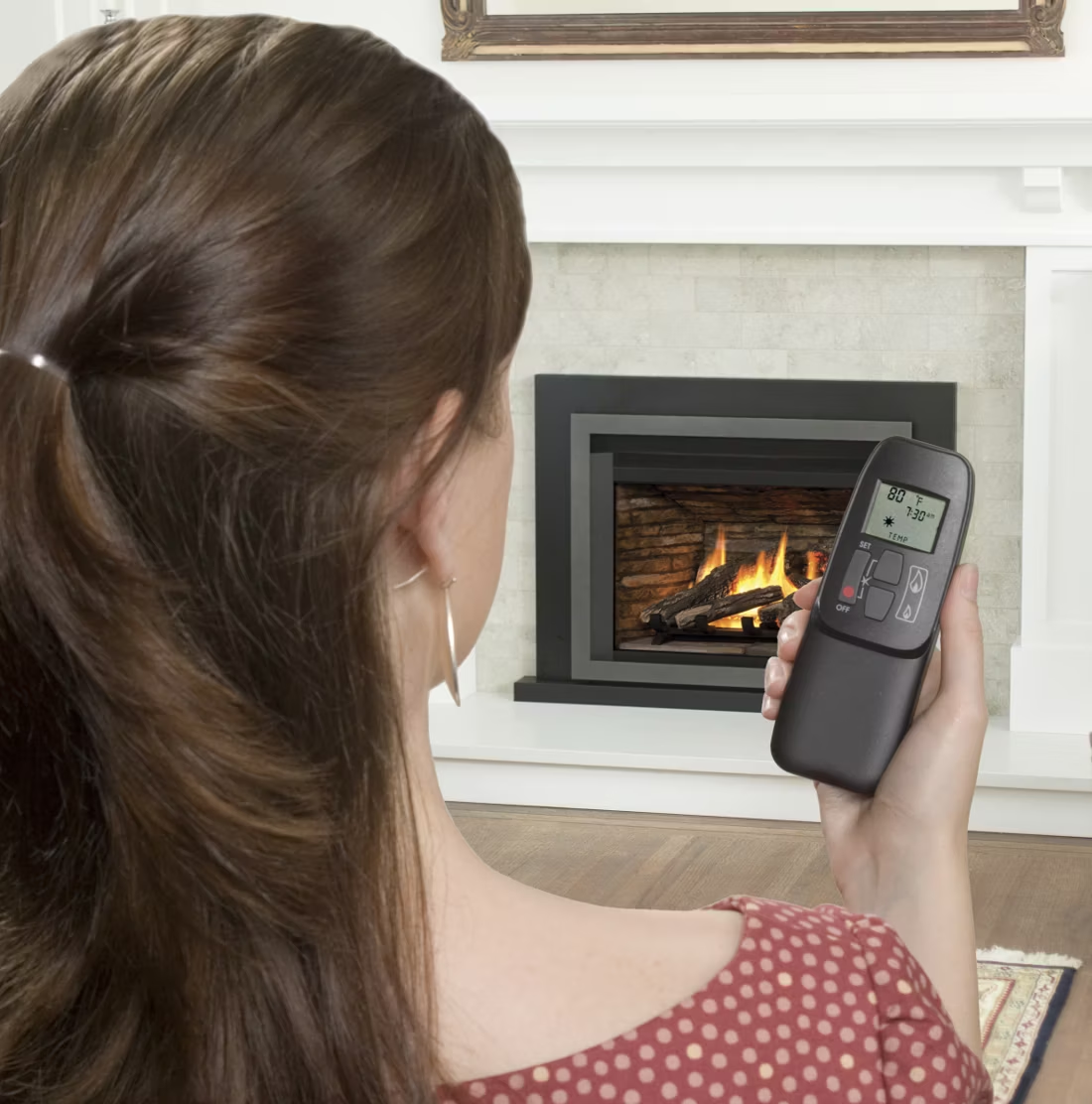
Most modern gas fireplaces can—turn it on and off from the couch with a remote, or set a room temperature and let the fireplace hold the comfort zone for you. If low maintenance matters to your family, this is the feature set that makes gas the convenience pick over wood and pellet.
Why do fireplace quotes vary so much?
Because a fireplace is an iceberg—there's more behind the wall than in front of it. A low quote often covers only the unit; the full scope includes vent pipe, gas line or electrical, framing, and the tile or stone that has to come off and go back on. Make every bidder price the whole job. If a dealer can't speak to the full scope with confidence, that's your signal to keep looking.
Why is my open fireplace making my house colder?
Open fireplaces suck—literally. As the fire burns, it consumes air your furnace already paid to heat and pulls it out through the chimney, so the house is actually colder after the fire goes out than before you lit it. An insert fixes this: it seals the chimney, puts fixed glass across the front, and turns that hole in your house into a real heat source.
Is my gas fireplace wasting gas?
If it was installed more than 15 years ago, probably. Older gas fireplaces keep a standing pilot light burning all the time, and that little flame can cost a couple hundred dollars a year. Newer models use pilot-on-demand ignition—the pilot lights only when you use the fireplace and goes out when you turn it off.
Nearby Dealers
Hearth shops serving Rocky Mountain House and the surrounding area. Every listing shows whether it is a WhyFire partner, a dealer we have verified as authorized for the brands we recommend, or a local business carrying hearth products. No manufacturer pays for placement. How we verify dealers →
Your Heat Source
Reinhart Ceramic Tile & Marble
Reinhard Ceramic Tile
Wild's Home Hardware
Battle River Landscape
Natural Gas Service in Rocky Mountain House
Confirm service at your address before planning a gas fireplace—a quick call settles it.
Atco Gas
Apex Utilities
Get your free Project Guide & Parts List for a Rocky Mountain House gas fireplace.
Tell us about your home and whether you're near ATCO Gas, Apex Utilities, or off the grid on propane, and we'll help you find a trusted local dealer and send a free Project Guide & Parts List with the exact vent kit and parts your project needs.
Find Your Fireplace →