
Fireplaces built for subarctic winters in Southeast Fairbanks.
Wood, gas, pellet, and electric fireplace resources for every community strung along the Alaska Highway—from Tok and Delta Junction to Eagle and Northway. Find the right unit for birch and spruce country and connect with a trusted local dealer.
Every Project Starts From One of These Five Situations
Heating a census area with 13,718 heating degree days.
Southeast Fairbanks Census Area stretches from Tok near the Canadian border west along the Alaska Highway through Delta Junction, with outlying communities like Eagle, Northway, Tanacross, and Dot Lake reachable only by side road or, in some cases, seasonally. With an average winter low of -13°F, cold snaps that regularly drop past -40°F, and 13,718 heating degree days a year, this area runs colder than well-known cold-weather benchmarks like International Falls, Minnesota or Fargo, North Dakota. Heating season here is closer to a year-round condition than a seasonal one, and wood—birch, spruce, and cottonwood, cut and split locally—has stayed the backbone fuel for generations precisely because it doesn't depend on delivery trucks or a functioning grid.
What you'll find on this hub: hearth retailers, service technicians, and fuel suppliers reaching every community in the census area—Tok, Delta Junction, Eagle, Northway, Tanacross, and the smaller settlements along the Taylor Highway. Pick your fuel below to see local dealers, realistic installation costs for this corridor, and the practical trade-offs of heating a home this far from a major supply hub. Whether you're outfitting a Tok cabin for its first winter or replacing an aging stove in Delta Junction, this is the starting point.
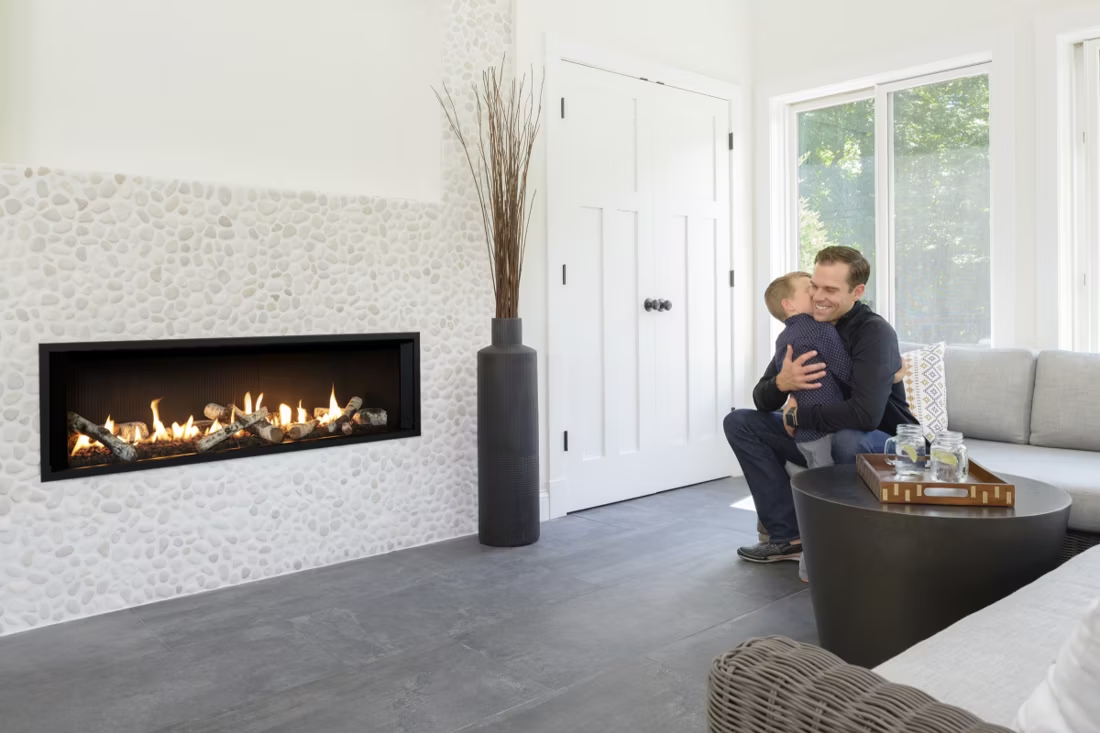
Four fuels. One honest answer for Southeast Fairbanks County.
Wood
See what's available near Southeast Fairbanks County.
Find your wood stove →Gas
See what's available near Southeast Fairbanks County.
Find your gas fireplace →Pellet
See what's available near Southeast Fairbanks County.
Find your pellet stove →Electric
See what's available near Southeast Fairbanks County.
Find your electric fireplace →Three steps. No salesperson until you're ready.
Tell us about your project
Your zip code, your situation, and the fuel you're leaning toward—or let the answers point you to one.
See what's actually available
The brands dealers within 100 miles genuinely carry—real options, never a catalog mirage.
Get your dealer & Project Guide
A trusted local dealer, plus the free Project Guide & Parts List that names every component of the job.
Frequently Asked Questions
Which fuel works best in Southeast Fairbanks Census Area?
Wood is the backbone fuel here, and for good reason—birch runs the hottest of the three common local species, spruce lights fast for kindling, and cottonwood fills in as a lower-density option, and none of it depends on a delivery truck or a working grid at -40°F. What locals call 'gas' is almost always propane, since no natural gas pipeline reaches this corridor; propane fireplaces and stoves give instant, thermostat-controlled heat and work well as a backup to wood. Pellet is a growing middle option—Superior Pellet Fuels and Lignetics bags come up the Alaska Highway by truck, giving you wood-style heat without splitting and stacking, though it does mean stocking pellets before winter rather than relying on same-week delivery. Electric is supplemental at best: most communities here are served by small independent or co-op power providers rather than a large interconnected grid, so per-kWh rates run higher and reliability during a cold snap isn't guaranteed. Most households run wood or propane as primary heat with the other as backup, and treat pellet or electric as a supporting player.
Do I need a permit to install a wood stove or fireplace in Southeast Fairbanks Census Area?
For most of the census area, no—the majority of this territory is unorganized borough, meaning there's no borough-wide building code enforcement or permitting authority outside the incorporated city of Delta Junction. If your property sits within Delta Junction city limits, check with the city office directly, since incorporated cities can and do adopt their own permitting requirements. Outside city limits, homeowners typically aren't required to pull a local permit for a wood stove or insert, though your homeowner's insurance carrier will very likely require proof of a UL-listed or EPA-certified unit and a clearance inspection before extending coverage. Propane line work is the one piece that stays regulated everywhere—it requires a licensed gas fitter regardless of local jurisdiction, and most retailers handle that step as part of the install.
Are there air-quality or wood-smoke restrictions in Southeast Fairbanks Census Area?
No—this area isn't classified as a nonattainment zone, unlike the Fairbanks North Star Borough about 100 miles northwest, which deals with well-documented winter PM2.5 and ice-fog issues tied to its denser population. With about 6,440 residents spread across thousands of square miles, Southeast Fairbanks Census Area doesn't carry the same wood-smoke concentration problem and has no mandatory burn-curtailment program. That said, ice fog can still form locally on windless nights during extreme cold, and choosing an EPA-certified catalytic or non-catalytic stove over an old uncertified unit still pays off—cleaner burns mean less creosote buildup, which matters when a chimney fire at -40°F is a genuinely dangerous emergency.
Can one local dealer handle wood, gas, pellet, and electric in this area?
Given a population of roughly 6,440 spread across the whole census area, retail here is concentrated in Tok and Delta Junction rather than spread across dedicated single-fuel showrooms—several hardware stores and co-ops stock hearth stoves alongside standard building materials rather than running a full display floor. Some households order pellet stoves or propane units through Fairbanks-based dealers who deliver and install along the highway corridor as part of a regular route. If you're comparing fuel types side by side, expect fewer walk-in showroom units than you'd find in Fairbanks or Anchorage—more of the process happens by phone and photo before a technician makes the drive out.
How does installation and service work given how spread out this area is?
Distances are real here—Tok to Delta Junction runs about 100 miles, and Eagle and Northway sit off the main highway, with some access seasonal or weather-dependent. Technicians travel the Alaska Highway and Taylor Highway for scheduled visits and typically bundle several jobs into one trip, so expect a travel fee and a longer lead time than you'd get in a city. Because a failed heating system or chimney fire at -40°F is a genuine emergency, most residents schedule annual service before freeze-up in September and keep a backup fuel source—often a wood stove as backup to a propane furnace, or vice versa—on hand for whatever goes down mid-winter.
What's the typical installation cost range across all fuel types in Southeast Fairbanks Census Area?
Costs run higher here than Lower 48 estimates because freight and technician travel add to every job. Wood stove or insert: $6,000-$12,000 for a typical install, more for full chimney runs on new construction. Propane fireplace, insert, or stove: $6,000-$13,000 depending on tank setup and venting, less if propane service already reaches the house. Pellet stove or insert: $5,500-$9,500, reflecting the added freight cost of trucking the unit and pellets up the Alaska Highway. Electric fireplace: $300-$3,500 for the unit, plus $500-$1,500 in labor for anything beyond a simple plug-in, given the travel time involved for a hardwired install. These are general ranges—your local dealer will give you an exact number once they've seen your home and chimney or venting situation.
Can I install a fireplace myself?
If you're putting a fire in your house on purpose, it's best to work with an expert. Unless you're genuinely experienced in framing, gas line, vent pipe, and the national code on clearances to combustibles, have a professional do it—and ideally the same company that sells you the fireplace, so warranty, service, and liability all live under one roof.
What is an in-home preview and do I need one?
It's a visit where a hearth professional measures your space, confirms the model you picked actually works in your home, and walks the specs—framing, gas line, venting, finish work—before anything is ordered. Some details you just can't know until you see the house. Never make a down payment without one; it's the single most-skipped step that burns buyers.
How much should I budget for a fireplace?
For an average home—covering the fireplace, the vent pipe, and basic installation—a budget between $3,900 and $5,500 gives you a lot of options across wood, gas, and pellet. By the time you add finish work, gas line, and electrical, the average complete installation lands between $5,000 and $12,000 all-in. In a remodel or new build, a good rule is to put about 2.5% of the total project cost toward the fireplace.
Can a fireplace actually lower my heating bill?
Yes—by creating a comfort zone. A furnace heats every square foot of the house just to warm the one room you're in; a gas fireplace on low burns roughly a sixth of the gas a typical furnace does. Set the furnace around 55–60 degrees as a baseline, then heat the rooms your family actually uses. Families who heat this way commonly save $20–$60 a month.
Get matched with a dealer in Southeast Fairbanks.
Pick your fuel below and we'll match you with a trusted local dealer who'll send a free Project Guide & Parts List—the exact parts, including the vent kit, sized for your home and this climate.
Find Your Fireplace →